
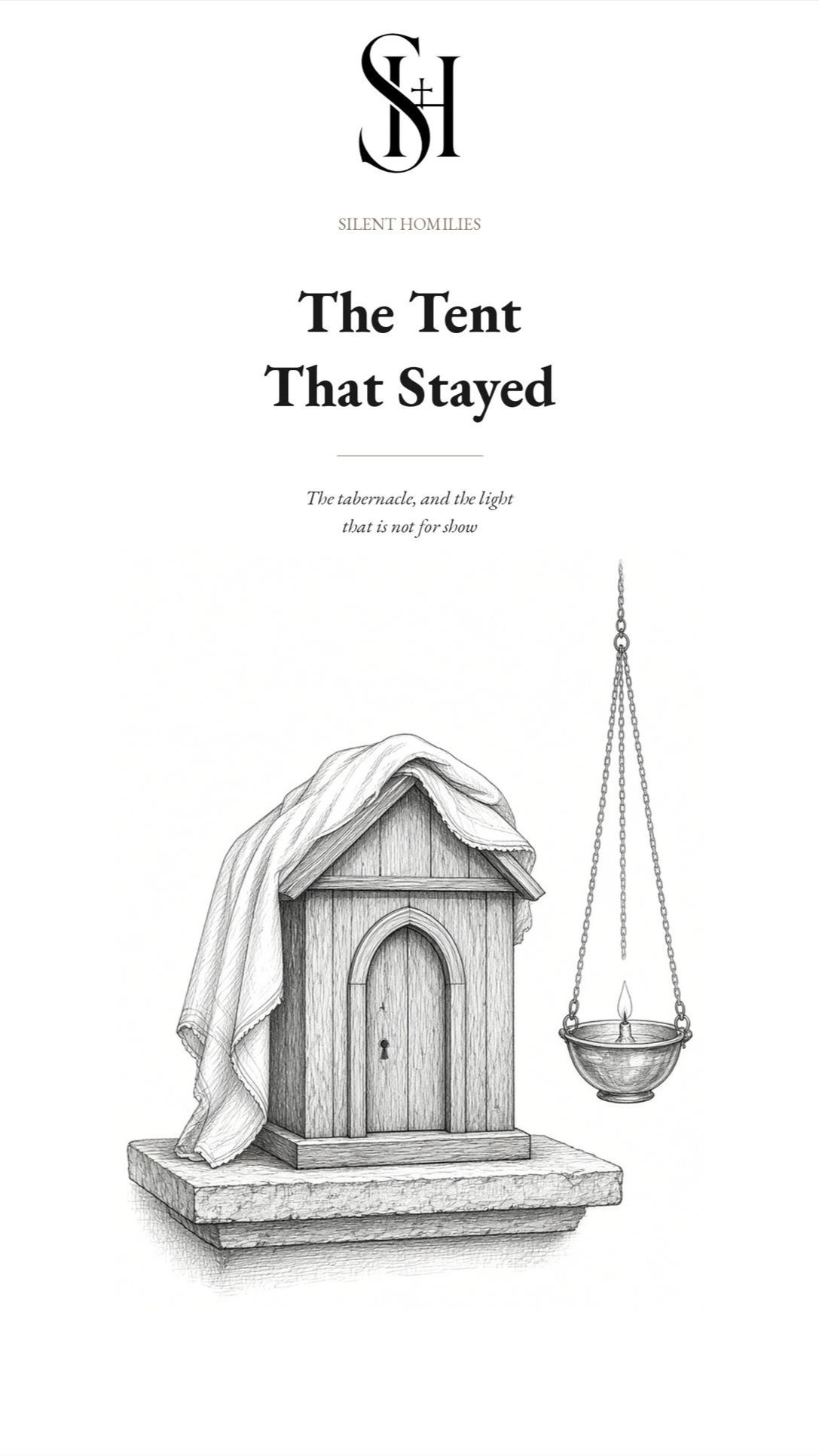
Most of us meet the tabernacle as a box we already understand. It sits near the altar, or in a side chapel, and a small lamp burns beside it. Then someone calls it a safe, and someone else calls it a shrine for looking at, and the Church’s actual teaching sits between those two reductions, unheard.
The Latin word is older than the box. Tabernaculum means a tent. Israel knew a tent in the wilderness. The Church reserved the Body of the Lord first of all for the dying — viaticum, food for the road — and only later built a house around that reserve. Before the locked cupboard on a reredos there was bread carried home, a golden dove hanging on a chain above the altar, a cupboard cut into an English wall, and stone sacrament-houses that rose almost to the vault.
This little book is not a campaign about where the box should stand, and it is not a catalogue of bronze. It walks through the key that is not a souvenir, the lamp that can go out, the veil that may never be black, the Thursday procession, and the Friday door left open on purpose. Read it if you have bowed toward that door for forty years and could not say why it is a door. Read it if you have only ever heard it called a box and suspected there was more.
The more is not gold. The more is a tent the Church declined to take down when the meal was over.
A Silent Homilies booklet. Written to be read in one or two sittings.