
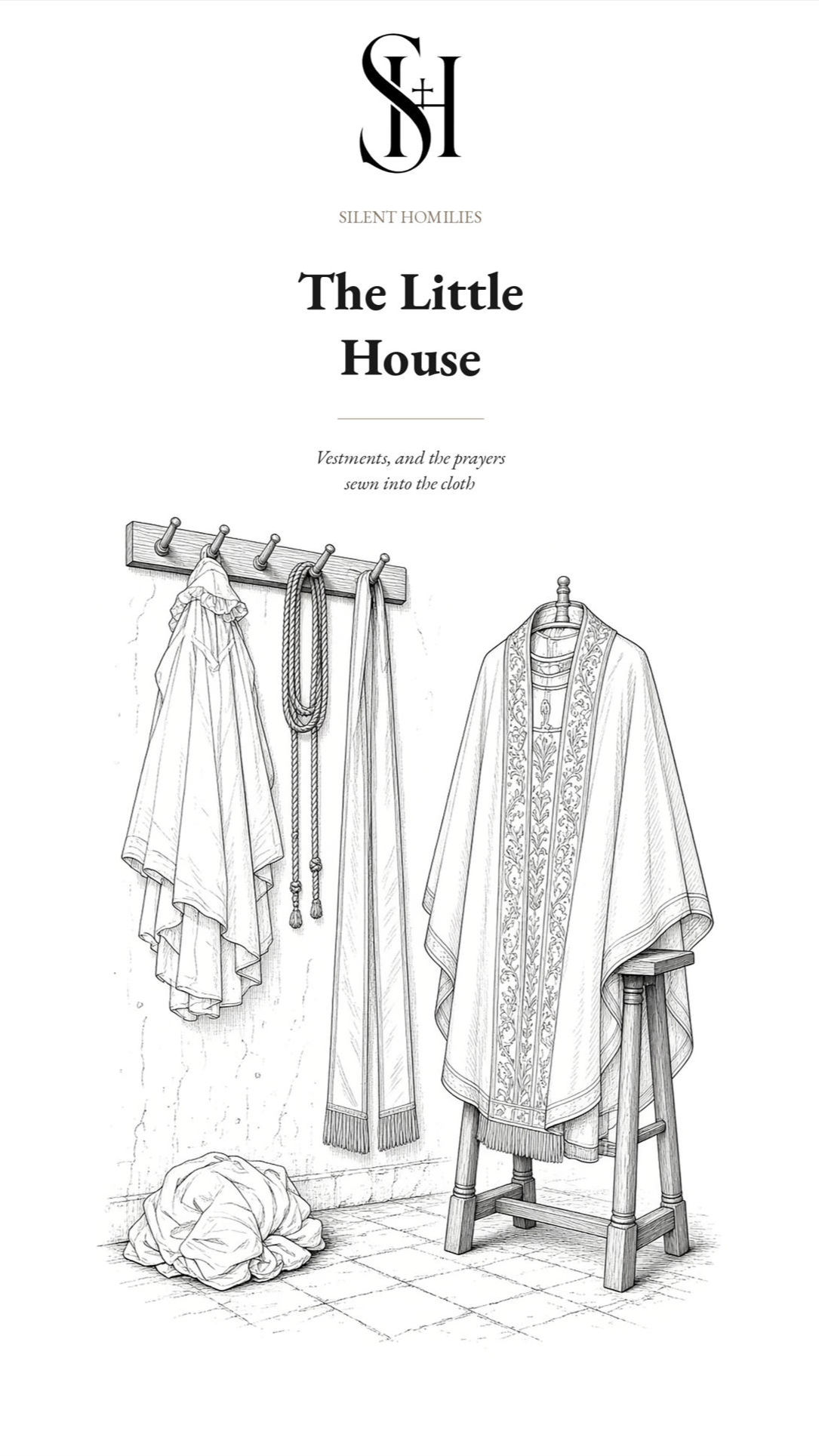
Most of us meet vestments as colour. Green again. Violet for a while. White at a wedding. The eye is not wrong. What the eye misses is the order of putting the cloth on, and the old sentences a priest may still say while his arms are in the sleeves. None of those sentences is about looking splendid. They are about being covered.
A vestment is not a uniform and not a costume. The Latin nickname for the chasuble is casula — a little house. He puts a house on. Then he goes to the table.
This little book is not a tailor’s catalogue and not a fight about lace. It walks through the sacristy in the old order: the amice no one in the nave will see, the alb that remembers a font, the cord, the vanished maniple that once named sweat and tears, the stole that hangs like a yoke, the deacon’s sleeved dalmatic, the cope that was a raincoat, the veil put between a man’s hands and the monstrance, and the thin wool a metropolitan wears because two lambs were blessed on St Agnes’s day.
Read it if you have watched a priest dress in a hurry and thought the cloth was only decoration. The sacristy is a quiet room on purpose. What happens there is already the Mass, begun in sleeves.
A Silent Homilies booklet. Written to be read in one or two sittings.