
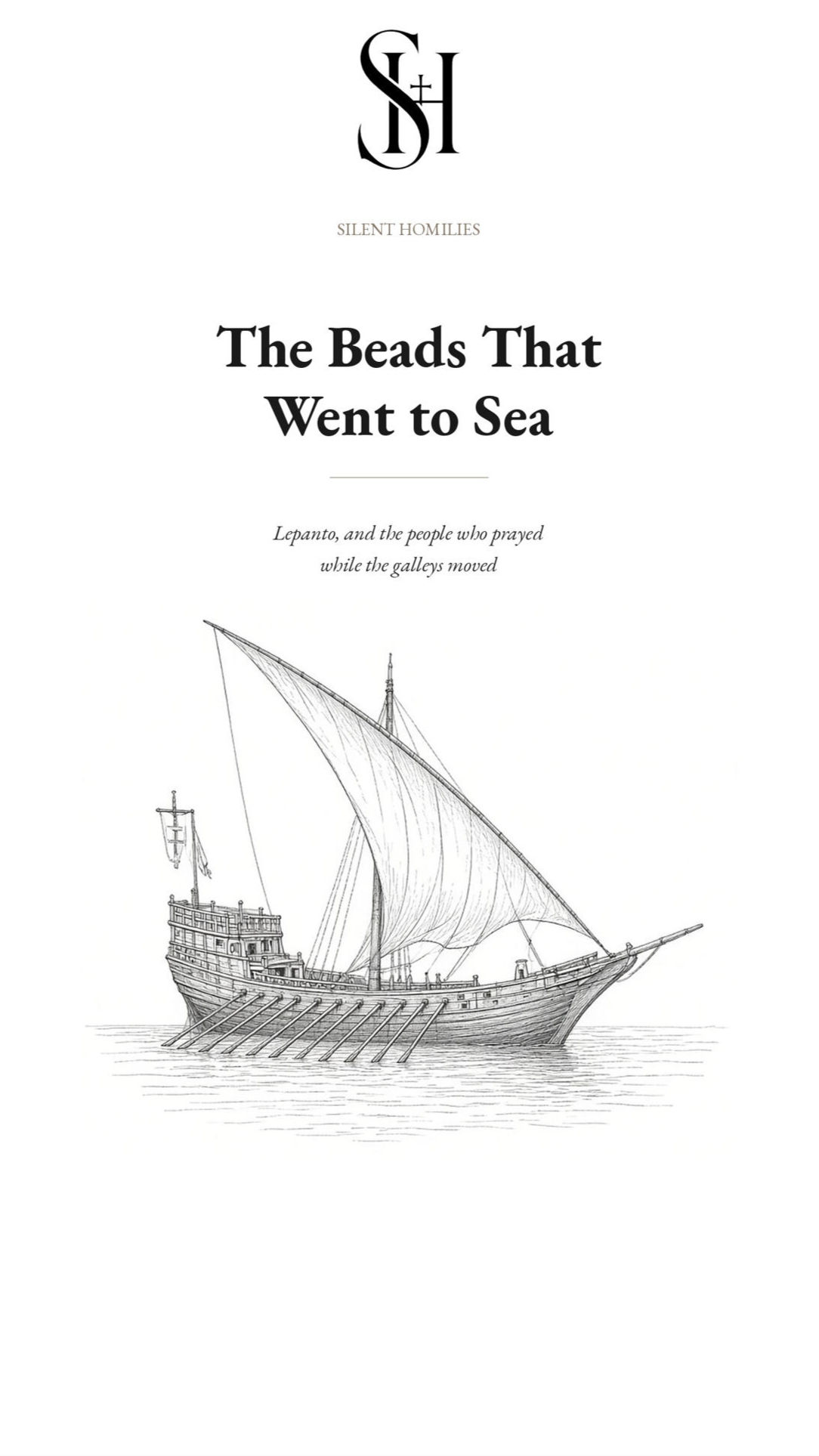
Most of us meet Lepanto already painted. Galleys locked together. A young commander in armour. Then someone says the Rosary stopped a war, and the sentence is either believed too quickly or dismissed as a holy-card legend. Between those two reactions sits a quieter story.
On 7 October 1571 the Holy League met the Ottoman fleet in the Gulf of Patras, off the town the West still calls Lepanto. It was the last great fight of oared galleys. What the Church chose to remember was not only the afternoon at sea. She remembered that Pius V, a Dominican pope, had asked the churches of Rome to stay open and the people of Catholic Europe to take up the beads. Sailors were given a string as well as a weapon. Women, children, the sick, and priests who could not leave their parishes counted in rooms that never smelled of pitch.
This little book is not a history of cannon. It walks through the league sworn in Santa Maria sopra Minerva, the twenty-four-year-old commander, the tradition of a wind that turned and of a window on the Aventine, and the decision — more surprising than any flag — to rename Our Lady of Victory as Our Lady of the Rosary. A battle cannot prove that prayer is a vending machine. It can remind a Church that ordinary asking is not wasted air.
Read it if the seventh of October has only ever been a title on a calendar. Read it if you have a rosary in a drawer and have never been told that some of the beads in 1571 never went to sea at all. They stayed on land, and the feast still belongs to them.
A Silent Homilies booklet. Written to be read in one or two sittings.